Sunday, November 17, 2013

Things i am expecting from the open source lang summit 2013

Hi,

  Almost start of the open source lang summit 2013. I think this is good time to list down things i am expecting from this summit.

  If you had chance to gone through my earlier blog [1] on the sprints plan for this summit, you might be already know the activities i was planning.

  Happy that all my sprint plans are got accepted and excited to work on it.

Fonts

Day 2
  1. (Sprint 1 )
- Lohit2
    - Hacking Telugu and Kannada Open type table
Telugu does not looks possible but i am optimistic for Lohit Kannada2, lets see if we can have at least alpha ready...

    - Testing of Released Devanagari and Gujarati
Devanagari Beta is out last week and Gujarati Alpha is yesterday itself. Hoping we will have some more thorough testing for same.

Day 2
(Sprint 2 )
Just idea presently on how we can use lohit2 reusable tables in long run
- Lohit-ise (Will give small 10min presentation on this)
    - Work on Devanagari and Gujarati fonts

   First of all i need to explain the concept clearly. Once that is done and there will be no doubts, we will try to implement it on Samyak fonts and if contributors are interested will help to implement it on other fonts.

Day 1
(Sprint 3 )
Time to update font packages in major OS distribution. One can learn packaging through this sprints. Expecting experts from different distribution packaging team will be there to help.
- Packaging AnjaliOldLipi,  Meera Tamil and SakalMarathi for Fedora, Debian and Ubuntu

I am sure we will have at least srpm ready for these packages for Fedora. Hoping debian packagers attending here will also able to push up .deb packages.


Input Method 

(Sprint 1)

ibus-typing-booster
    - Packaging for Debian and Ubuntu

 Now sure about this yet. :( So looking around Debian and Ubuntu packagers.
 Porting ibus-typing-booster to fcitx is not required as fcitx following little bit different architecture. Thanks for fcitx main developer for explaination.

 (Sprint 3)

ibus-typing-booster
Presentation and testing event.

I am excited for this. I am damn sure attending will have so much to take out after this sprint.

(Sprint 4)
Plan is to create layout images for inscript2 layout.
- Keyboard Layout Images
    - Porting mapper scripts to support inscript2 layouts
    - Update Fedora wiki images of keyboard layout


Parag is going to lead this session. Looking forward we will have something handy and helpful in this session.

  Welcome to all attendis.

Please ignore typos and grammar mistake ;)

1. http://pravin-s.blogspot.in/2013/10/open-source-language-summit-nov-2013-in.html

Thursday, November 07, 2013

Lohit Devanagari Beta release test file screenshot !!

Lohit Devanagari

Lohit 2 Devanagari Beta is out already[1]. This is screenshot during testing

Testing Environment :
Fedora 19, Application gedit
gnome-shell-3.8.4-2.fc19.x86_64
harfbuzz-0.9.23-1.fc20.x86_64
lohit-devanagari-fonts-2.92.0-1.fc19.noarch
Source file: https://raw.github.com/pravins/lohit/master/devanagari/test-devanagari.txt


Same environment as above
Source file: http://pravins.fedorapeople.org/test-file-devanagari.txt

1. https://www.redhat.com/archives/lohit-devel-list/2013-November/msg00000.html

Thursday, October 31, 2013

Lohit2 surely helping identifying critical bugs and improve rendering stack for long time.

lohit-devanagari is almost ready for beta release after resolving number of issues reported at git [4]

I am happy while testing lohit2 devanagari we are not only fixing issues from fonts side but we found interesting bugs from application side as well.

Earlier it was from Harfbuzz NG side. [1] This bug sometime very difficult to identify since even when expected ligature does not come it looks like there is ligature. During thorough testing with hb-shape and by looking at glyph names we identified yes this is problem. Then we tested with other fonts around and no one was giving expected results.
Thanks to Behdad for quickly fixing this it made life easy for doing Beta release.

Now few days back we identified one more bug from Libreoffice [2] This is also tricky one. Surprisingly this was working well with NotoSans Devanagari so one might think it is font issue as it work well with other fonts.
But again with thorough analysis we found that changing glyph class of first-i-matra to base-class doesn't solve the issue but create other problem for forming reph ligatures.  [5]

This time survivor is Khaled, good to see he committed the fix today itself.  Though my testing is remainign but he resolved the root cause i think.

From Fedora side, as Fedora is the always leader for quick fixes from upstream. Caolan again proved that by providing build [3] for fix today itself. Thats simply great !!!

I am sure over the time we will done with Lohit2. We will definitely identified major issues in rendering stack of opensource and will have the fixes also ready with excellent people around. I am reoommending community member to participate in lohit2 testing since this will help for long time to have perfect fonts and Open type layout shapers around.

Though this making bit delay in lohit2 releases but i think perfection comes first :)


1. https://bugs.freedesktop.org/show_bug.cgi?id=69266
2. https://bugs.freedesktop.org/show_bug.cgi?id=71080
3. https://bugzilla.redhat.com/show_bug.cgi?id=1025201
4. https://github.com/pravins/lohit/issues 
5. https://bugs.freedesktop.org/show_bug.cgi?id=70968#c9 

Tuesday, October 08, 2013

Open Source Language Summit Nov 2013 in Pune (Sprint ideas)

Hi All,

   I am sure people who were part of this summit last time must be excited to attend 2013 Open Source Language Summit as well.
   As a planning we (Parag and Anish) discussed possible hackthon's we can do in this summit and we listed down following items:

Language Support:
    Identifying availability of basic components for 287 languages. (Unicode, Locale, Fonts, IME and rendering support) Mostly comparing with Wikipedia and Fedora language support.

Fonts:
Lohit2 project for "Creating standard and reusable Open type tables for Indian script font" [1] has already took pace with the release of Lohit Devanagari Alpha and start of work on Gujarati and Kannada. Its humble goal of creating language rendering tables so that font can render perfect across platform makes it priority item for summit. Following are things we are planning.
(Sprint 1 )
- Lohit2
    - Hacking Telugu and Kannada Open type tables
    - Testing of Released Devanagari and Gujarati

(Sprint 2 )
Just idea presently on how we can use lohit2 reusable tables in long run
- Lohit-ise (Will give small 10min presentation on this)
    - Work on Devanagari and Gujarati fonts

(Sprint 3 )
Time to update font packages in major OS distribution. One can learn packaging through this sprints. Expecting experts from different distribution packaging team will be there to help.
- Packaging AnjaliOldLipi,  Meera Tamil and SakalMarathi for Fedora, Debian and Ubuntu

Input Method 
Ibus typing booster [3] is predictive text input method supporting 41 languages  for in opensource world. Number of people using it and given positive feedback on it. During last few conference i got request from active opensource users to make it available on Debian and Ubuntu as well. Planning this activity in this summit.
(Sprint 1)
- ibus-typing-booster
    - Packaging for Debian and Ubuntu

(Sprint 2)
Not sure how much change will be need to port ibus-typing-booster to fcitx framework. Will discuss and see what we can do for this. Help from users and Developers of fcitx is welcome from all perspectives :)
- ibus-typing-booster
    - Porting to fcitx

(Sprint 3)
During last one year number of features has been added to it. Presentation and testing event for same.
- ibus-typing-booster
    - Presentation on ibus-typing-booster features
    - Testing for Indian IME's support

(Sprint 4)
Plan is to create layout images for inscript2 layout.
- Keyboard Layout Images
    - Porting mapper scripts to support inscript2 layouts
    - Update Fedora wiki images of keyboard layout

Rendering Engines
(Sprint 1)
This bug was identified during the lohit2 development. Unfortunately Behdad will not able to attend this summit, so will try to debug and see if we can provide patch to fix this.
- harfbuzz
    - hacking on  "glyph moving across syllable boundries" bug [2]


1. http://pravin-s.blogspot.in/2013/08/project-creating-standard-and-reusable.html
2. https://bugs.freedesktop.org/show_bug.cgi?id=69266
3. https://fedorahosted.org/ibus-typing-booster/

Sunday, September 29, 2013

Workshop from W3C-India on "HTML 5 tour in India" 25th Sept 2013 Pune

    Cant call it exactly workshop, it was more like demonstrating power of HTML5 and explaining concepts and increasing awareness so more and more people start building powerful websites based on HTML5.

    Workshop  in Pune city  was one of the part of whole HTML5 tour in India. W3C India's plan was to cover major regions of India and spread the thought everywhere. W3C guys covered different topics at different cities (See program for more details [1]).

    Was lucky that after long time got a chance to meet Raymond Doctor, we discussed on some projects and planned to meet soon to discuss more on those. 

    First time got a chance to hear CDAC DG Prof. Rajat Moona [2] and liked his motivation speech of explaining how technologies evolved during the time.

    After his talk In pre-lunch session Michael smith [2] calmly explained W3C initiative and motivatoin behind each initiative. Basic motivation is solving the problems. He expressed his concern about though W3C is developing protocols faster but due to dependence on web browsers it does not reach to masses in timely manner.

    I really appreciate Michael for the way he answered each question from audience in very detailed way.

    Post lunch session was mainly on webRTC. I am really impressed with the demonstration of the webRTC and i am sure it is going to be one of the threat to video conferencing application. Some of Machael's session on webRTC are already available on youtube.

    Mr. Mahesh Kulkarni explained about the importance of epub3 guidelines w.r.t. complexities of Indian scripts.

       I have done some tweets during the workshop, one can find it from [4].

    Workshop was housefull. There were number of students present. Due to small size halls some audience was attending workshop on projectors. I think W3C should really improve this and next time plan for auditorium with more capacity.

    Since most of the people only attended one of the part of whole HTML5 tour, i requested w3cindia provide videos of sessions happened in other cities. I think it will be made available on w3cindia website.

1. http://www.w3cindia.in/HTML5-tour-2013/program.html (Still not understanding why this link is not opening in Firefox sometime)
2. http://www.cdac.in/html/message/dg-profile.aspx
3. http://people.w3.org/mike//
4. https://twitter.com/search?q=%40prravins%20%23html5&src=typd

Thursday, September 19, 2013

Before the alpha release of Lohit Devanagari from Lohit2 project

   I am hoping now most of the contributors around are aware regarding the lohit2 project. Before the Alpha release of Lohit Devanagari i think it is important to go through once again goals we planned for this project[1].

    Goals:

    1. Cleaning Lohit Open type tables.
    Highlights are as below
  • We rewritten all GSUB rules from scratch.
  • New rules are supporting both deva and dev2 script tag
  • Done testing on Harfbuzz as well with Uniscribe and its giving expected results.
  • Kept GPOS tables intact.
  • Effectiveness and efficiency [2]  (sfd file size is down by 28K and Binary file side is down by 4K)
    Found one bug w.r.t harfbuzz [3] and looking forward to get it resolved soon. Presently it is in know issue list.

    By Beta we will have some more improvement on this.

    2. Reusable Open type tables.
    We got two important suggestions on this line, so below are suggestions and action taken on it.
    1st suggestion
    To have feature file separate than shapes .sfd file for easy re-usability of OT rules.
  • Thanks to AravindaK, he has already done some work on that line[4], so just using those stuff. I have forked this gitrepo and doing some improvement in it. Once done will request Aravinda to merge with his repo.

    2nd suggestion
    To follow AGL[5] and to have readable glyph naming.  We were also thinking from this perspective.
  •   This has became a bit complex glyphlist.txt [6] suggest names like "kadeva" or uni0915. But we dont want to follow uni0915 as it is not very readable considering our re-usability goals.
  • {0915 (kadeva) + 094D (viramadeva) + 0937 (ssadeva)} following this create chances of glyph name string more than 31 characters limit.
  • So present plan is follow above "kadeva_viramadeva_ssadeva" as much as possible and if it goes above 31 characters we will discard "deva" part from glyphname.

    3. Following of existing standards/guidelines
    Dont know how many of you aware regarding "Devanagari Script Behaviour For Hindi"[7] Draft, so its basically guideline for Font developers. I have one blog pending on this. Though this is draft mode we are trying to follow this, since it is very informative and prepared after consulting to language experts.

    This is where we upto, if anything more needed do provide me your feedback. Also need to decide on release version, i think some version with -alpha will work.

1. http://pravin-s.blogspot.in/2013/08/project-creating-standard-and-reusable.html
2. Effective means it should work on all supported platform perfectly and efficient means compact and clear rule
3. https://bugs.freedesktop.org/show_bug.cgi?id=69266
4. https://github.com/aravindavk/
5. https://sourceforge.net/adobe/aglfn/wiki/AGL%20Specification/
6. http://kaz.dl.sourceforge.net/project/aglfn.adobe/glyphlist.txt
7. http://tdil-dc.in/tdildcTemp/articles/75443Consolidated%20Feedback%20&%20Observations%20on%20Draft%20Devnagari%20Script%20Behaviour%20Ver%201.4.8_June_13.pdf

Tuesday, September 10, 2013

One of the happenning event FUEL GILT conference 6-7 Sept 2013 @ Pune, India

    I would like to start this blogpost with saying one of the successful conference happened during recent times in GILT industry in India. One can get idea from the power packed program schedule[1] with highly weighted name like Mr. Sam Pitroda.

    One of the very useful things was govt. was involved in this conference. Govt's positive approach to get things done in opensource way was very motivating to opensource contributors. Hoping this will go further ahead and we will get major contributions from government in each opensource project like FUEL.

    Another point was most of the opensource contributors from well known organizations were present. It was really great to see all of them. Having Anivar from SMC in conference was very useful. He given very useful comments in most of the sessions.

    I am sure attendees now have clear understanding of complexities of Localization industry and hurricane task done by the communities over the years.

    Though first day Keynote speaker was not able to attend, Satish Mohan and Mahesh Kulkarni very nicely motivated the audience and educated them regarding FUEL efforts.

    I liked Zanata session from Ani Peter. Features available in Zanata project are really good. Specifically liked the feature of allowing two translator chat while working on same project and decide on words choice. Question from audience regarding having localize instance of Zanata was really well worth.

    Rajat Gupta session on "Towards generation of translation memories from varied file formats from distributed/unorganized data" created interest in audience regarding how can they use there different format localize data to create translation memory.
   
    Talk by Ms. Sushma Chitta on "Application of Simplified Technical English in globalization of the content." was interesting. The guidelines of  Simplified Technical English (STE) was nice. I am not aware regarding any such open standard.

    Rahul Bhalerao Ex-Red Hatter  explained the importants of understanding target audience thoroughly before doing translations.
   
    Good part from the  conference perspective was audience was very vocal and attentive.

    It was good meeting Karthik, mostly interacted with him on bugzilla and mailing list. He presented on WMF activities on i18n sides. Also good to Goraji after long time, i remember we worked together for fixing sorting issues in glibc. Looking forward to see some more contributions from him.

    Dinner was good had nice discussion with Mr. Pavanaja U B he told how he started developing open type fonts during 2001. (That time i was doing my first year of engineering ;)). He promised help for Lohit2 Kannada development.

    Had a nice conversation with Omshivaprakash. We were discussing about bug in gnome-shell [2] Tested it today but not able to reproduce same. Was happy to see one more gnome-shell fan. :)

    Arjuna Rao Chavala talk was nice and his interest in improving Indian language uses across communities is impressive. Though English is important as a business language i am sure people will not forget there language. Easy to use basic i18n components are key factors.

    Twitting was good experience in this conference with gang :)

    Second day keynote by Mr. Sam Pitroda was great. He provided information regarding National Translation Mission and also emphasized on point that Machine translation is required to handle huge data.

    Talk by Mr. Guntupalli Karunakar on "Indic fonts: Guidelines and Standardization" was well taken, i am sure Lohit2 [3] will solve number of issues presented by him.

    Anivar explained importants of targeting mobile devices for Indian languages. Lots of work needed to happen in that domain.

    Enjoyed interaction with audience during my talk on IME's evolution. Good part was audience included highly experience localization people and same time there was developers working on i18n components and last but not the least the student/freshers wanted to learn as much as they can. I am sure that audience understood the problem and soon we will have my new proposed IME architecture available everywhere. Lots of expected from me, hoping will try to do it.

    Panel discussion was good. We saw good scope for further development of FUEL. Though at sometime we were loosing direction Ankit did well to keep focus on FUEL only.

    Soon one can get presentations pdf and also videos of talk recording on youtube. I missed Dr.  Nagarjuna G during this conference as he is the one who bring me to Indian language computing and opensource.

    I would like to end this blog by thanking Rajesh, Ankit, Chandrakant for organizing such a nice conference. Expecting some more next time :)


1. http://www.fuelproject.org/gilt2013/program
2. https://bugzilla.redhat.com/show_bug.cgi?id=1005471
3. http://pravin-s.blogspot.in/2013/08/project-creating-standard-and-reusable.html

Thursday, August 22, 2013

Project: Creating standard and reusable Open type tables for Indian script fonts

Background information:

     As most of you know Lohit [1] is one of the widely used and default Open source fonts for most of the Indian languages. It gives perfect rendering irrespective of OTLS (though now it is harfbuzz-ng earlier there were different open type layout shapers icu, pango, qt).

    Earlier due to incompatibility of different open type layout shapers we did number of bug fixes in Lohit fonts which created some redundant gsub tables, even i will say some logically wrong gsub table to get perfect rendering on all OTLS. Also in some of the script fonts like Kannada we have some unnecessary glyphs.

    During this time we got Open Type 1.6 specification (Dev2) and also long awaited Harfbuzz NG [2] project in now working and included in most of the leading project. (Gnome, Libreoffice etc.)

What is goal?

1. Cleaning Lohit Open type tables.

        Basically going to rewrite open type tables for all script fonts present in Lohit as per OT 1.6 specification by following best practices (compact OT tables by using minimum glyphs as much as possible).

 2. Reusable Open type tables.

    Discussed this idea in last year language summit in Pune with Aravinda.

    So basically we have very limited number of fonts for Indian script and i think one of the reason behind that is complexity of creating fonts for Indian language. It requires script, designing/calligraphy and engineering knowledge (OT technology, hinting) and bit other technicalities.

    Providing easy to use, reusable open type stuff will definitely remove some complexities from this. In long term it will help to make font developers life easy.

3. Extension to Open type specification.

    Again this started in Lang summit 2013 with Santhosh. We created initial draft in sumeet (https://docs.google.com/document/d/1f8rCjva6AceWuzoOXMTeK24IoyBRUErtRm0Zrvyn0S8/edit#heading=h.c7vik2gjwesj) for this and i think santhosh has moved bit more forward in this.

    Basic motivation behind this was existing open type specification is not providing sufficient information for Indian script and font developer need to create guess work while writing Open type tables. So we want to have one specific standard for Indic scripts.

        So basically we can add and update this standard while rewriting open type tables of Lohit.


Present status of project

    This project is presently available at https://github.com/pravins/lohit2, Presently Sneha [3] is actively working on it. if anyone interested feel free to join.


1. https://fedorahosted.org/lohit
2. http://www.freedesktop.org/wiki/Software/HarfBuzz/
3. https://github.com/snehakore

Wednesday, July 31, 2013

Indic typing booster is now ibus-typing-booster

   I am sure that most of the Fedora users should be familiar with this change. We started this change due to number of architectural changes and increase in the scope of project.

  ibus-typing-booster is very actively developed in last couple of years and now has number of essential and add-on features required for predictive text input method.  I will soon start documenting these features and if time permits will create one screencast demonstrating it.

  Since indic-typing-booster  mailing list does not going to have anymore update from onwards, i will simply add all id's subscribed here to ibus-typing-booster (cc'ed) mailing list and disable indic-typing-booster mailing list.

  Looking forward to have some good debates on ibus-typing-booster soon.

  Thanks all for supporting, motivating and contributing to indic-typing-booster.

Monday, June 10, 2013

Fedora shows Tofu (Square Box/Dabba) for following Unicode scripts

Was just going through GUCharmap to check how many scripts are still not covered with the default fonts installation of Fedora. Still number of fonts required to remove Square-Box/Tofu/डब्बा/ and provide at least single font for each script of Unicode. Though i think NBMP ( non basic multilingual plane script) is not high priority target first but at least other script on BMP which are in active use must be supported.

Thought it will take long time.

Below is the list from GUCharmap showing for scripts represented as  Tofu/SquareBox :)

Missing fonts in fedora

- Avestan
- Balinese
- Bamum
- Batak
- Brahmi
- Buhid
- Carian
- Chakma  - NBMP
- Cham
- Cuneiform
- Cypriot - NBMP
- Deseret - NBMP (supported by noto)
- Egyptian Heiroglyphs - NBMP
- Imperial Aramaic - NBMP
- Inscriptional Pahlavi - NBMP
- Inscriptional Parthian - NBMP
- Javanese
- Kaithi - NBMP
- Kharoshthi - NBMP
- Limbu - NBMP
- Lisu
- Lycian - NBMP
- Lydian - NBMP
- Mandaic - NBMP
- Meroitic Cursive - NMBP
- Meroitic Hieroglyphs - NBMP
- Miao - NBMP
- Mangolian
- New Tai Lue
- Ol Chiki
- Old South Arabian - NBMP
- Old Turkic - NBMP
- Phags Pa - NBMP
- Rejang
- Samaritan
- Saurashtra
- Sharda - NBMP
- Shavin - NBMP
- Sora Sompeng - NBMP
- Sundanese
- Syloti  Nagri
- Tagalog
- Tagbanwa
- Tai Tham
- Tai Viet
- Takri - NBMP

While comparing this with Google's noto fonts, they have provided fonts for some of the scripts in the above list. Will add those to Fedora soon.

Thursday, April 25, 2013

Resolved Lohit Oriya rendering issues with Harfbuzz NG

Couple of weeks back got to know there are some combination of Oriya breaking with Harfbuzz. Bug [1] was earlier reported against Zanata but later on with further review understood it is actually font problem.

Cross checking with Windows found those are breaking with Uniscribe as well.

One of that combination was 123 Gsub listed at UTTRS[1]

 ର୍ତ୍ତ  (U+0B30 U+0B4D U+0B24 U+0B4D U+0B24)

Reph was not allowing to form expected ligature

Same way there are some other combination like 52 ( ଞ୍ଜ)

If someone type ି or ୈ,  It was not allowing to form expected ligature.

Fixed these combinations in upstream now.  [2]
Build lohit-oriya-fonts-2.5.3-3.fc18 will be available in tomorrow update-testing repo. [3]


Fedora language testing day is planned on 2013-05-02 [4]


If none more issues get reported during this test day, i will do next release of lohit-oriya that is 2.5.4.


[1] https://bugzilla.redhat.com/show_bug.cgi?id=923215
[2] http://utrrs-testing.rhcloud.com/language/or/gsub            
[3] https://git.fedorahosted.org/cgit/lohit.git/commit/?id=28986ab3956df5cb96c3ec383641f1cb0fa4c04a   
[4] https://admin.fedoraproject.org/updates/lohit-oriya-fonts-2.5.3-3.fc18
[5] https://fedoraproject.org/wiki/Test_Day:2013-05-02_Localization_%28i18n%29


Tuesday, April 23, 2013

My view on Automated_Rendering_Testing idea for GSoc from SMC

Just couple of days someone ask my view on this project. Today got some time to go through it, below are my comments.

Project idea is written her http://wiki.smc.org.in/SoC/2013/Project_ideas#Automated_Rendering_Testing

1. I really like that someone picked this idea for GSoC. This is something we are looking from long time in UTRRS.
    UTRRS has one basic drawback that manual intervention is needed to get actual rendering problem.
    So if some intelligent algorithm program can automatically verify standard images and on the fly generated image from font to be tested and provide comparison that will be simply great.

    When i gone through project title i thought this is going to be happen in this project.

    I am not sure what is exact plan for implementation.

2. It is written in project idea "One method to do this might be to check the order of glyphs/glyph index output by the rendering engine - this depends on the font too."

   Actually in Harfbuzz we are already doing this thing with scripting.  Behdad has implemented best testing suite for testing rendering of complex script. It happnes following way.

  Script first passes particular word and font to be tested to Uniscribe. It returns some glyphs id's/hex values in fonts.

  Then script passes same word and font to Harfbuzz. It also returns some glyphs id/hex values in fonts.

   Assuming fonts works 100% perfect in Uniscribe and considering it as a standard output. If harfbuzz output (hex values) matches with uniscribe (hex values) it means it is rendering perfect else test fails.

  With this method in harfbuzz we already automatically testing millions of words.

3. In my humble opinion this project should be plan with my first point. I do agree it is tough and might be bit research kind but i think that is the right way. Harfbuzz is already doing automates rendering testing by passing values to unscribe and other open type layout engines.

Wednesday, February 13, 2013

Open source language summit 2013 at Red Hat Pune and Me

Almost at the end of second day of Open source language summit at Red Hat Pune more details regarding it are available at [1]

This blog is specifically for the things on which i worked on in this summit.

1. Standard for Open font format for script of India
It is available at [2] in very initial stage right now. With this document we are trying to improve Indian language fonts development experience of Typographers or Font Designers.
But how? good question :)

See today number of Latin fonts available freely and also in open source environment but not Indian fonts number in that strength.

Agree there might be many reasons but one of that is complexity of development OFF fonts. Unlike Latin it is not simply design but also handling complex script features like reordering, ligature and understanding open font format.

We are planning to make this standard document so easy and simply that anybody want to develop font can simply design shapes required for script and follow some easy steps by referring references fonts like Lohit and done.

Though long road ahead but i am sure this step is in right way !!

2. Lohit fonts will be available as a Web fonts from upstream itself

Completed all work from updating Makefile in Lohit upstream (Thanks parag again for initial work :))

Got some useful information from Santhosh regarding sfntly tool from google for generating .eot and .woff

So from now onwards no need to rebuild lohit in other font format for using it as a Webfonts, just use lohit-

Monday, December 03, 2012

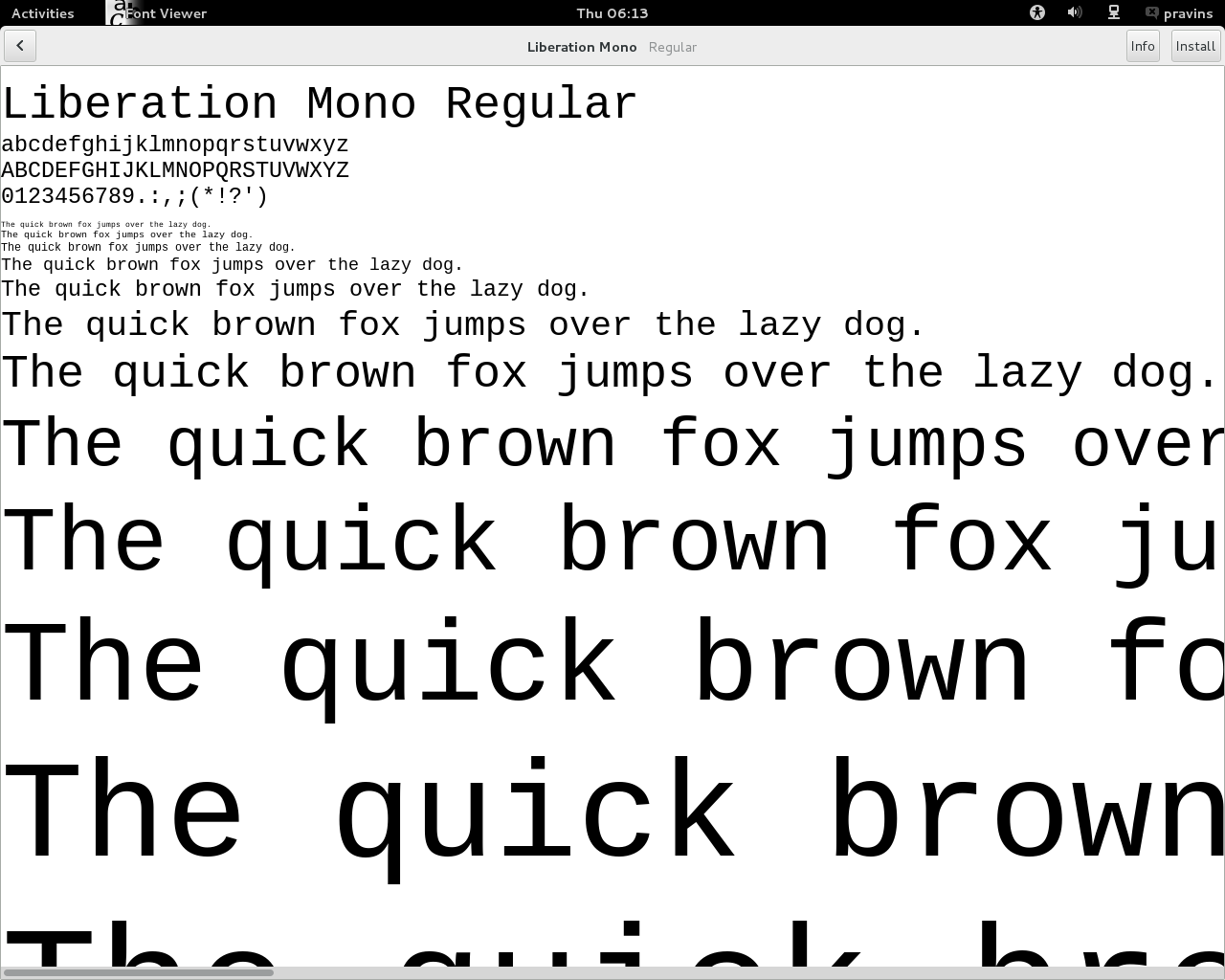
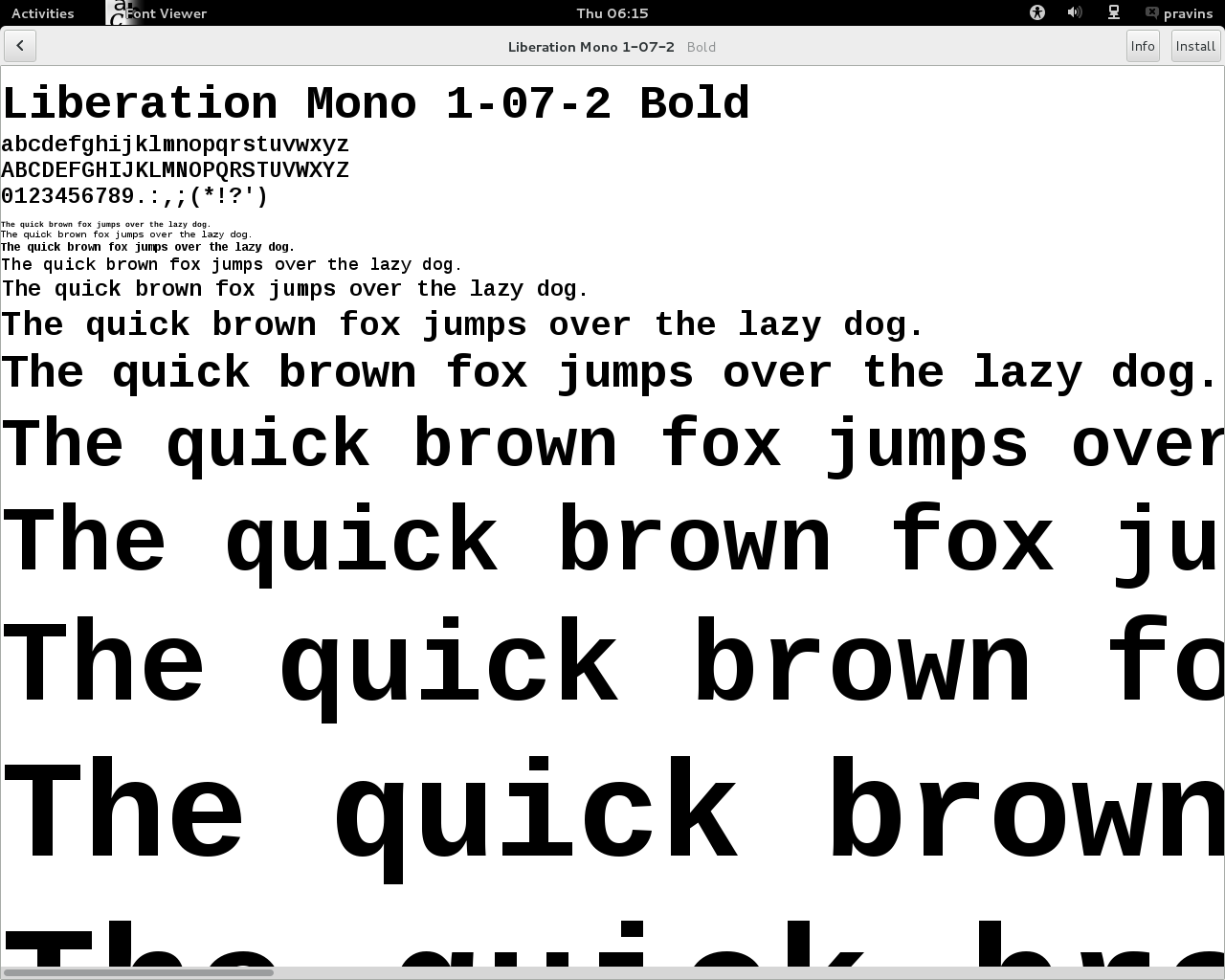
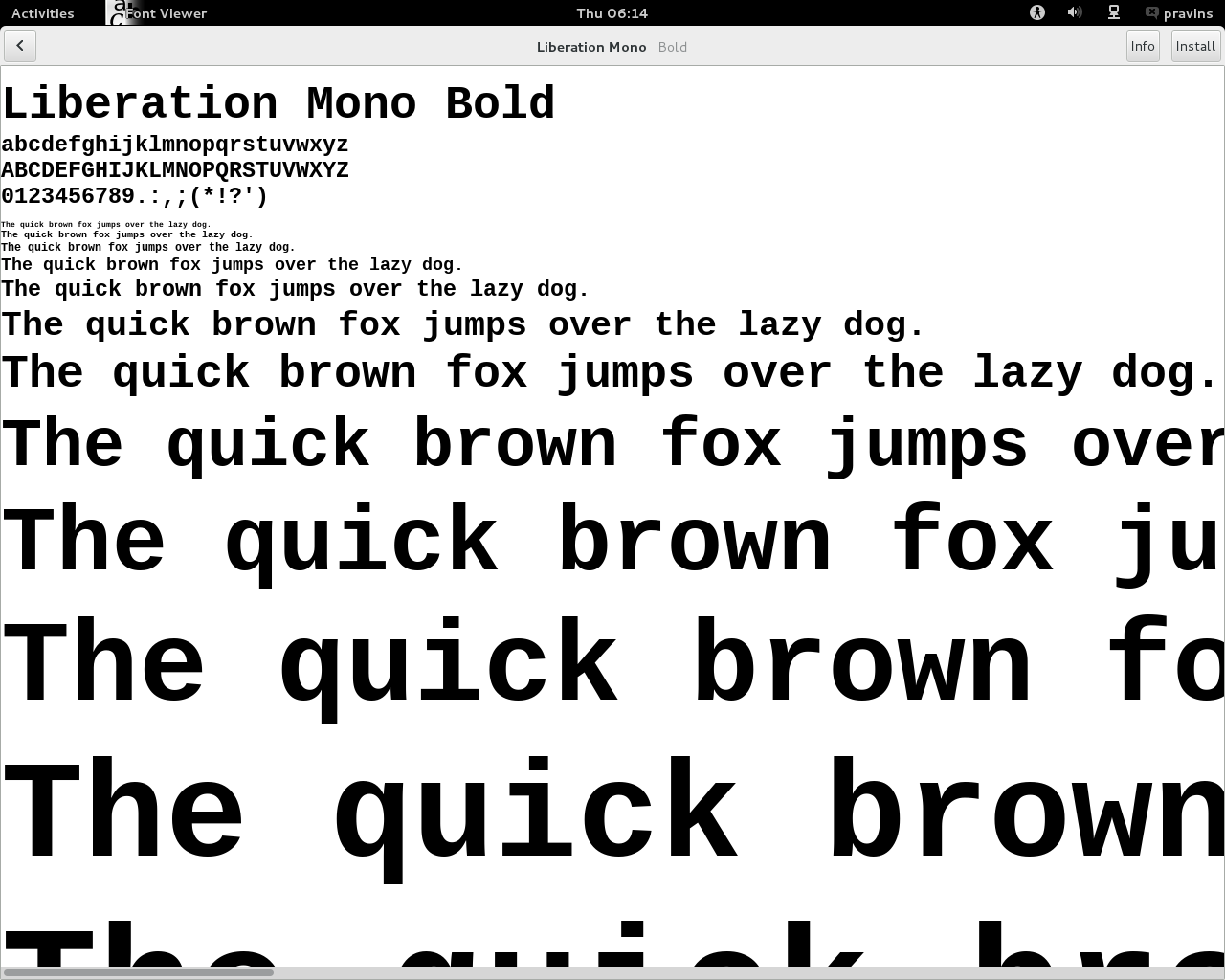
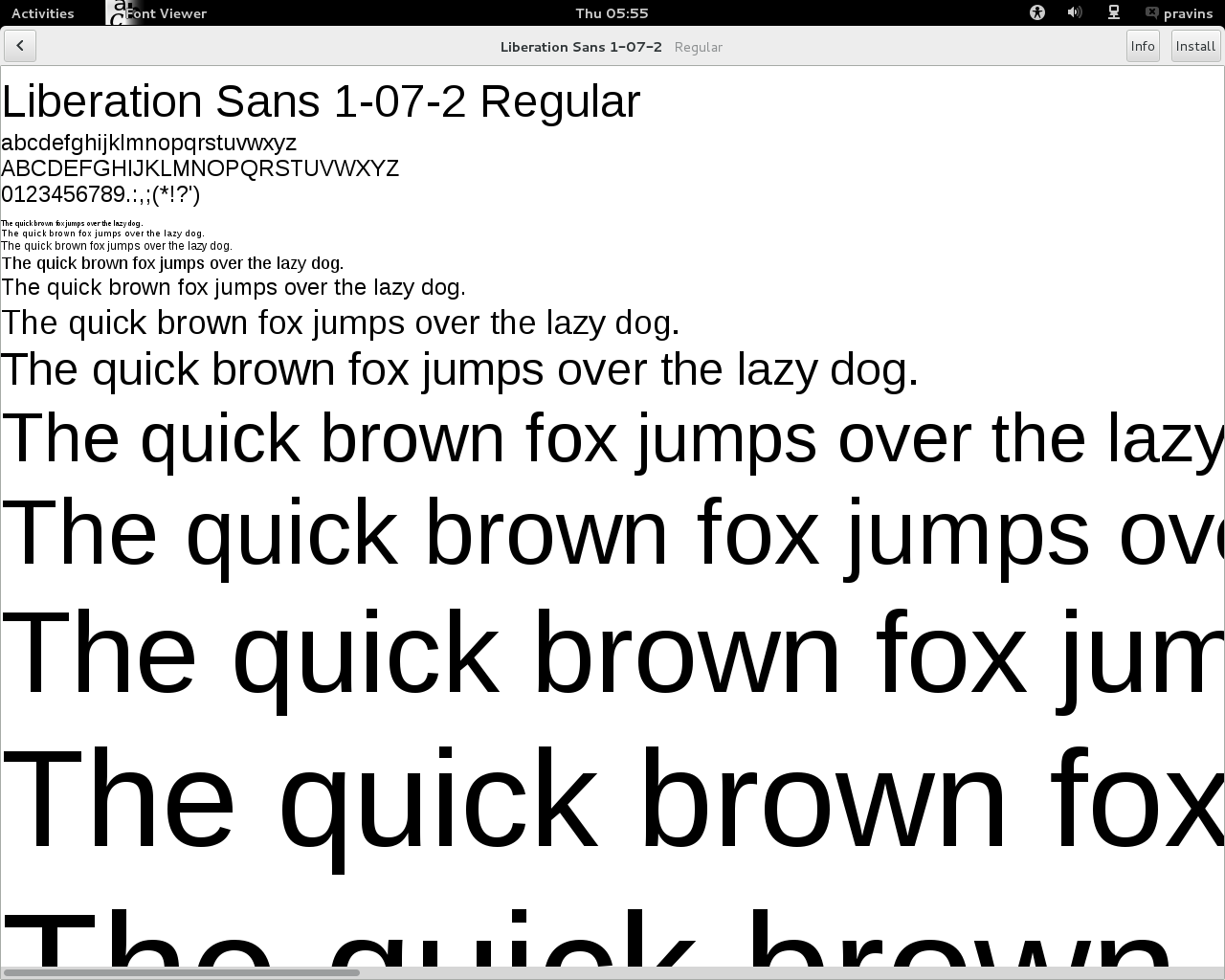
Liberation 2.0 and Liberatoin 1.0 comparisons

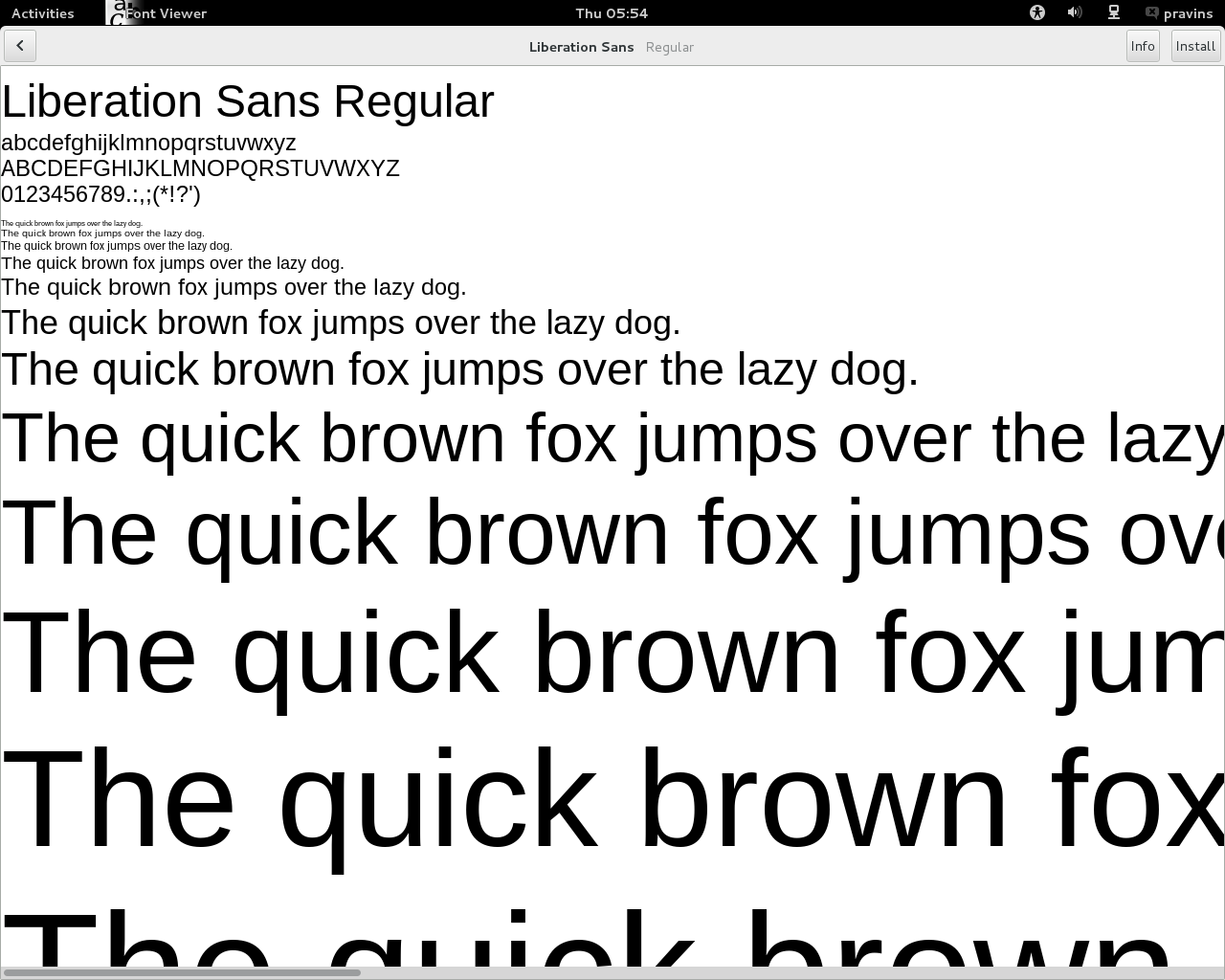
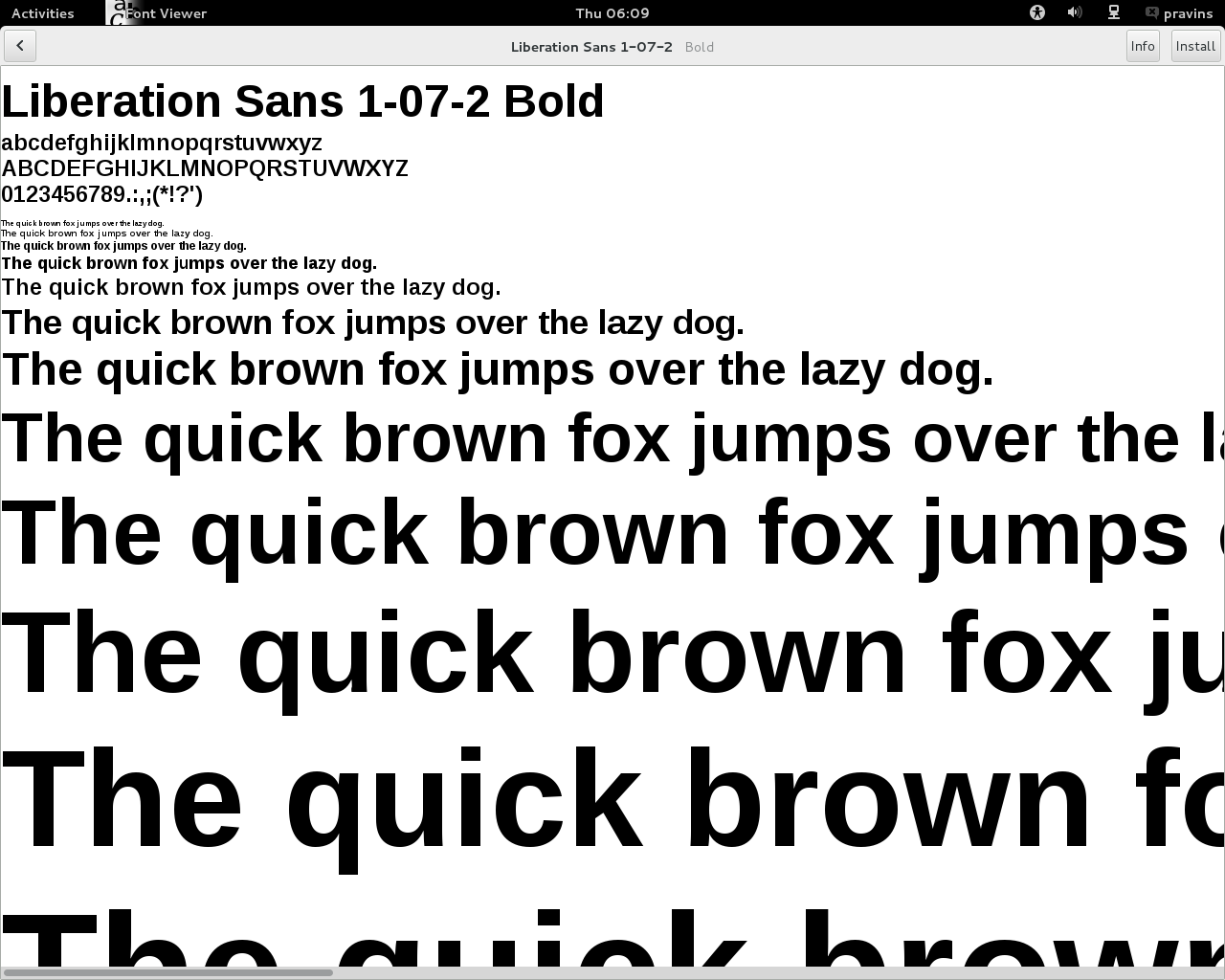
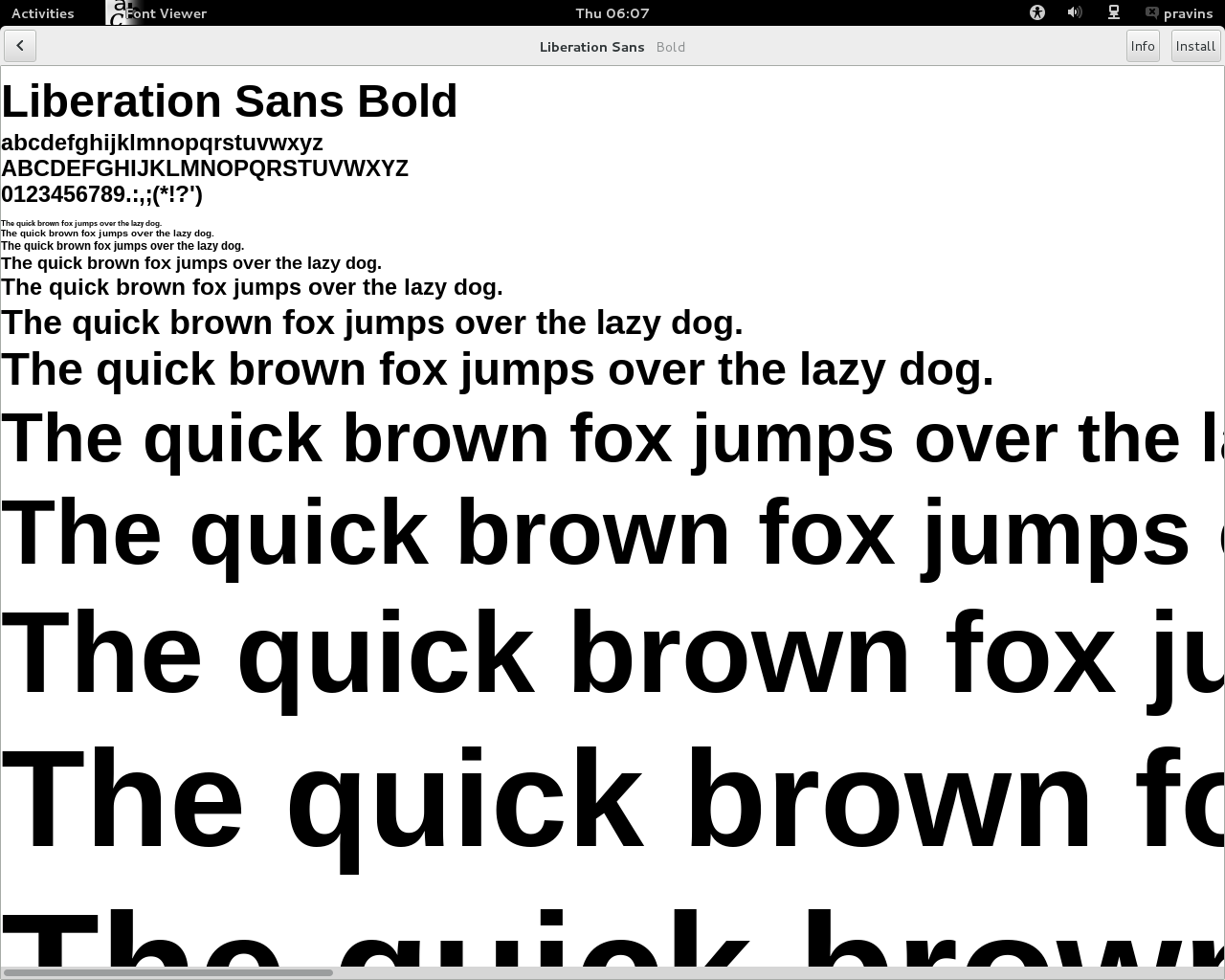
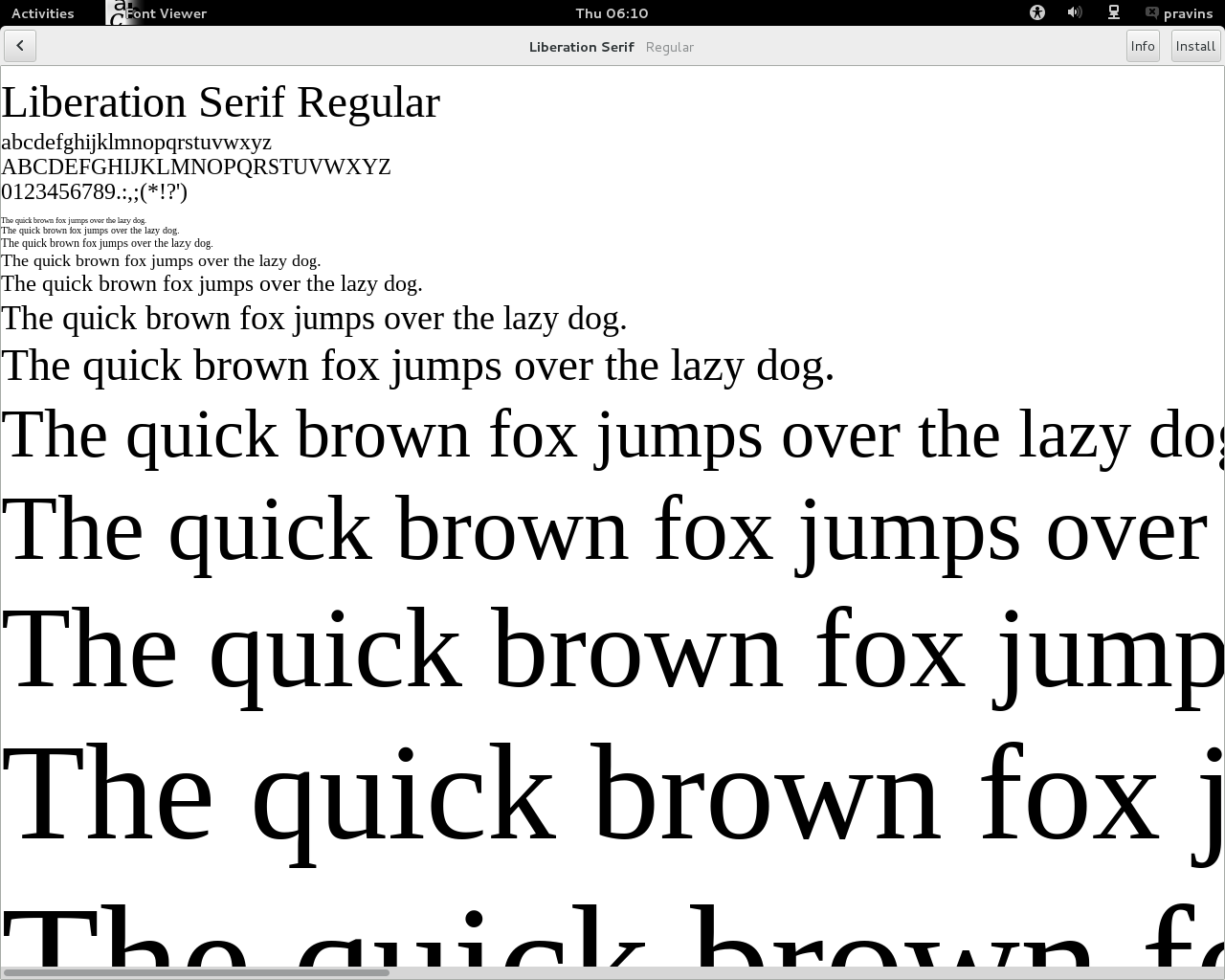
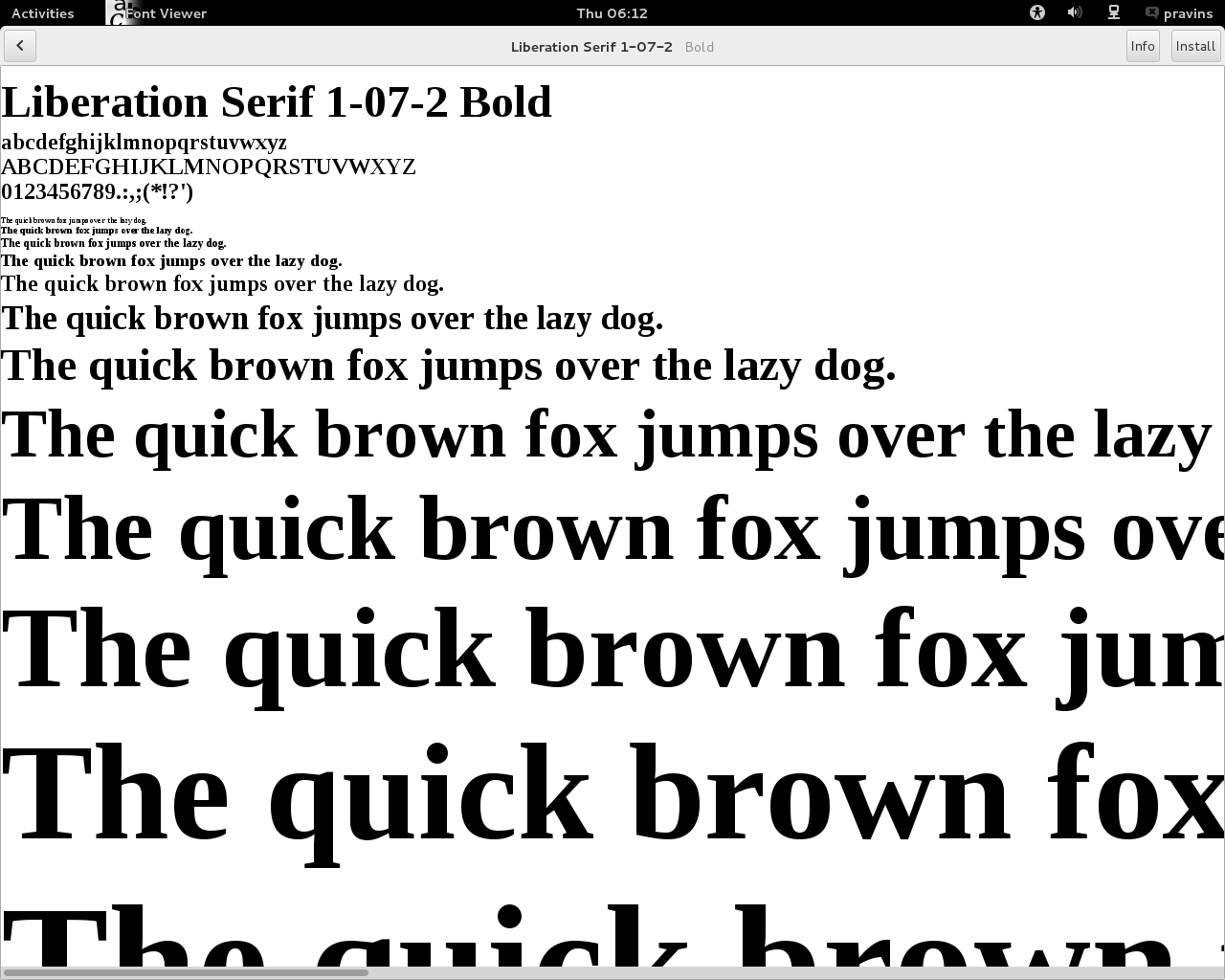
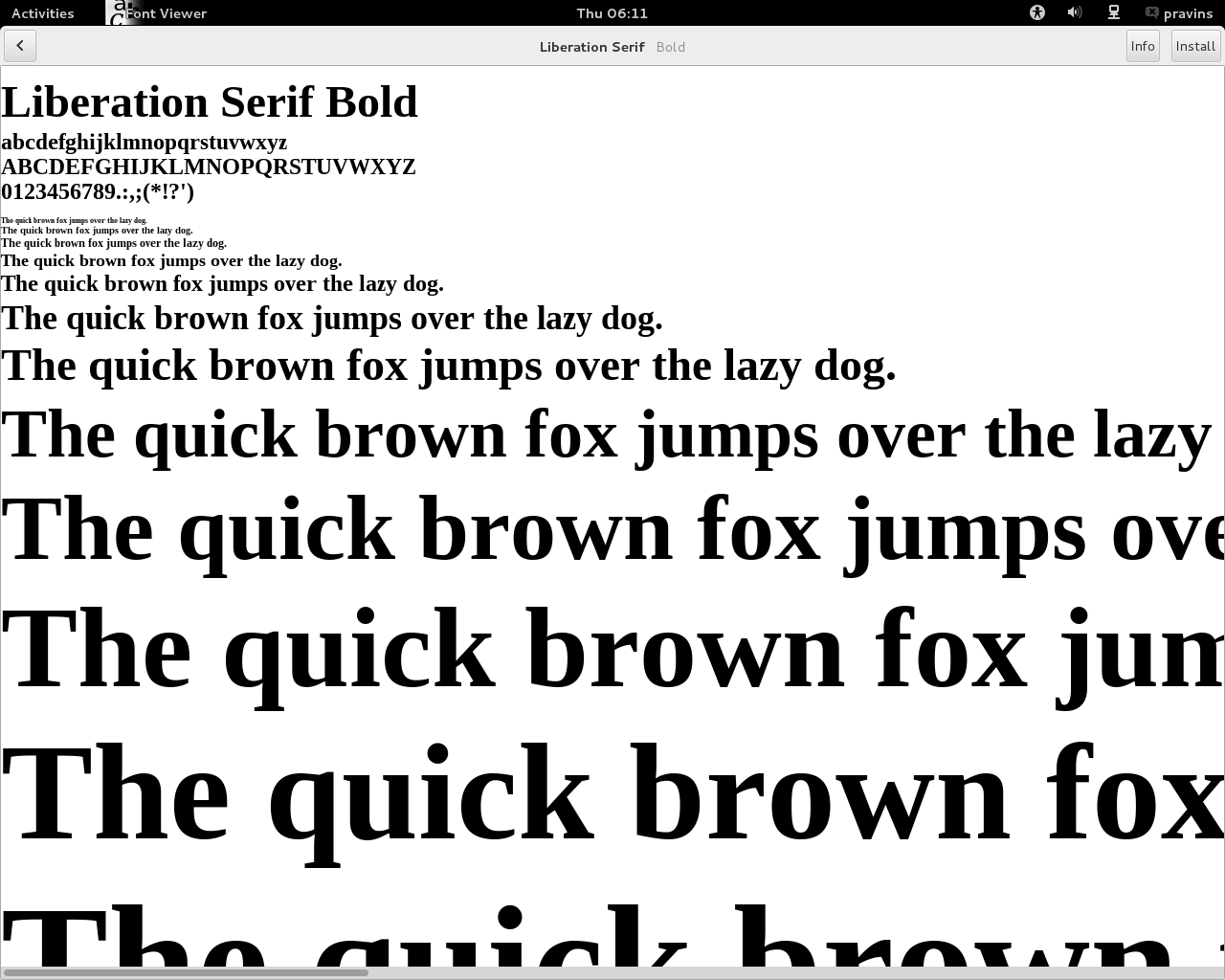
 Liberation 2.0 is one of the feature of Fedora 18. but Below are some comparison screenshots between liberation 2.0 and liberation 1. See the at smaller sizes and higher sizes output is same.

Liberation Mono 1.0  Vs Liberation Mono 2.0


Liberation Mono Regular 2.0


Liberation Mono Bold 1.0

Liberation Mono Bold 2.0

Liberation Sans Regular 1.0

Liberation Sans Regular 2.0

Liberation Sans Bold 1.0

Liberation Sans Bold 2.0

Liberation Serif Regular 1.0

Liberation Serif Regular 2.0


Liberation Serif Bold 1.0


Liberation Serif Bold 2.0


Wednesday, May 30, 2012

Indian internationalization enhancements in Fedora 17


    Yesterday Fedora 17 Beefly Miracle got released and this is time to update on enhancement and new features of Indian languages.

Indian official 22 language support
    This is one i am aiming from long time and glad to tell you achieved this in Fedora 17. Now we support i18n for all these language. This is definitely one of the major achievement by Indian open source community.
    We now have fonts, rendering support (mostly new languages are based on Devanagari ), Input methods (Inscript and for some inscript2)

Challenges we faced
  • CLDR
    - Most important part we were looking for locale data. Unfortunately we do not have much active contributors for missing languages in opensource community.
    - So searching them was big pain. Lucky enough finally found some. Got Bodo locale from Unicode CLDR itself.
  • Fonts
    - Lucky enough new languages are using Devanagari scripts as well, so some minor fixes in Lohit Devanagari made it compatible with newly added language.
  • Input method
    - We do have inscript layout for most of the language. Missing languages layout is standardize with the Enhanced inscript kayboard development.
  • Fontconfig
    - Fonts were not getting selected for languages due to improper or missing orthography file, special thanks to tagoh for taking time to review all ortho file and commit it in upstream.
Unicode 6.0 compatibility for supported script
  • Lohit fonts now supports Unicode 6.0
Details available at http://fedoraproject.org/wiki/Features/IndicUnicode6

english-typing-booster
    English Typing Booster is a predictive input method for the ibus platform. It predicts complete words based on partial input. One can then simply select the desired word from a list of suggestions and improve one's typing speed and spelling.
    http://fedoraproject.org/wiki/Features/english-typing-booster


Enhanced inscript layout
    I do agree the standard is still in Draft stage. It almost two year we are waiting for getting it release as a standard.
    Inscript2 has some major enhancements over the existing keyboard. This will give community a better chance to test and provide feedback.
    Also inscript2 support more languages, so at least we can make it available to community having no standard for input method yet.
    Example: Kashmiri in Devanagari
     More information at http://fedoraproject.org/wiki/Features/Inscript2_Keymaps

Font configuration tool
   This one many people are waiting for long time.
    Many time users do not like default system fonts, they either want to change it with some downloaded fonts. This tool allows them to do it.
    Just download font, install it. Run fonts-tweak-tool and select font under particular category and ok. 
    It will create custom fontconfig file for users, and user will get selected font for language as a default. Yahoooooooo!!
       More information at http://fedoraproject.org/wiki/Features/FontConfigurationTool

Other improvement
  • Language specific Lohit fonts for  Nepali and Marathi
    - We were using Lohit Devanagari for these languages early with locl feature of Open type fonts. Still 'locl' feature does not work well with most of the rendering engine.
    - As well users in India use to be in en_US locale.So now provided fonts Lohit-Marathi and Lohit-Nepali users can get there expected localize shape without any dependency.
  • smc-fonts
    - SMC community has done improvements and resolved bugs in Meera, Rachana and other fonts. These are available in Fedora 17.
  • Fonts for kannada
    - navilu and gubbi fonts are now available in Fedora. If anyone wants to use this as a default for Kannada just do it with fonts-tweak-tool.
  • Indic typing booster
    - Major news it is now supporting Bengali language with Probhat, itrans and inscript layout. Do give it try. Enhancements for presently supported languages.
Road ahead
  • Following languages are written in multiple script, we are presently supporting it in Devanagari so need to support in other scripts as well.
    • Santhali (Ol Chiki)
    • Manipuri (Meetei Mayek)
  • In Fedora 18 we are going with ibus-hunspell-table, it uses better architecture for predictive text input method than existing typing booster. 
    • More efficient by using hunspell dictionary in backend. At one go it support all m17n layout.
    • It supports all languages available in hunspell
  • Liberation fonts with better license.
  • This is from my side i am sure there are many more :)

Tuesday, February 21, 2012

Soon releasing Lohit Marathi

Today is "International Mother Language Day" and what more i can do for my mother tongue than announcing soon release of Lohit-Marathi with the shapes specifically required for Marathi writing.

From Long time we are using Lohit Devanagari which is generic for all languages using Devanagari script. Recently found official document showing Marathi language need some specific shapes different than other languages like Hindi @ Bug (discussion happened during wikimedia hackthon and meet with redhat i18n team)

Official Document available at http://www.maharashtra.gov.in/GR/Marathi/2009/11/06/20091106130447001.pdf

Within next couple of week will release it, so people on any Linux or windows can install it and enjoy truly Marathi Lohit font.

Sunday, January 15, 2012

Resolved bug in Rachana font

Just resolved one bug of Rachana font.
Below is list of Malayalam Unicode characters

"ം ഃ ഄ അ ആ ഇ ഈ ഉ ഊ ഋ ഌ ഍ എ ഏ ഐ ഑ ഒ ഓ ഔ ക ഖ ഗ ഘ ങ ച ഛ ജ ഝ ഞ ട ഠ ഡ ഢ ണ ത ഥ ദ ധ ന ഩ പ ഫ ബ ഭ മ യ ര റ ല ള ഴ വ ശ ഷ സ ഹ ഺ ഻ ഼ ഽ ാ ി ീ ു ൂ ൃ ൄ ൅ െ േ ൈ ൉ ൊ ോ ൌ ് ൎ ൏ ൐ ൑ ൒ ൓ ൔ ൕ ൖ ൗ ൘ ൙ ൚ ൛ ൜ ൝ ൞ ൟ ൠ ൡ ൢ ൣ ൤ ൥ ൦ ൧ ൨ ൩ ൪ ൫ ൬ ൭ ൮ ൯ ൰ ൱ ൲ ൳ ൴ ൵ ൶ ൷ ൸ ൹ ൺ ൻ ർ ൽ ൾ ൿ "

Before fix it was looking like, Note, U+00AE character is displayed even at reserved unicode locations, was not understanding from where ® is coming after checking through all font understood in Rachana.ttf these glyphs present.


After Fix

Reported bug : https://bugzilla.redhat.com/show_bug.cgi?id=781938
patch is available in bug. Pushed update to Fedora 16 https://admin.fedoraproject.org/updates/smc-fonts-4.4-7.fc16

Wednesday, December 28, 2011

Added Bengali language support in Indic typing booster

   Finally done with Bengali support for indic-typing-booster, working from last 5-6 days, actually we could have done this yesterday itself but initially i thought probhat (mostly used in community) is phonetic layout like itrans but later understood it is one-to-one mapping layout. So thought its better if to add phonetic layout as well since mostly new user find phonetic layout more user friendly.

   Hunspell word list made life little bit easy, but its huge wordlist around 3Lakh (.3 Million), not sure how much actually useful for Booster IME. If we can delete few words not related or very similar it can help to reduce Database size. Will discuss this in Bengali community and will take some inputs.

   Unlike first released of other language, from onward User no need to install all layouts rpm together, done sub-packaging in spec file. Users familiar with Probhat should install bengali-typing-booster-probhat, users familiar with inscript should install bengali-typing-booster-inscript and phonetic one should install bengali-typing-booster-phonetic. Considering db size hoping this will help to reduce download and install size. Rpm's are available at koji.fedoraproject.org/koji/taskinfo?taskID=3608241, scratch build. Raised Fedora new package request hoping to get quick review and build it for Fedora 17 and Fedora 16
   This is Beta release 0.9.0, with some bugfixes and comment will release 1.0.0 soon.

Monday, November 21, 2011

Wikimedia hackthon 1st day

Amazed with the passion and spirit of wikimedia team during hackthon. Eric gave good starting explanation of basic things of wikimedia and other ongoing activities, such that offline support, mobile support, internationalization.

Hackthon project list was excellent http://www.mediawiki.org/wiki/India_Hackathon_2011#Topics

I was interested in all but since all activities were parallel thought better to check Lohit fonts support for remaining Indian languages.

I was the leader for font testing activity http://www.mediawiki.org/wiki/India_Hackathon_2011/Schedule_notes#I18N
Glad to see 4-5 hackthon attendees shown there interest in font testing.

Pre lunch session went in introduction of project, group forming etc. Actual work start after lunch.

first 1 hrs i was just enabling students OS for Indian language, couple of had Fedora in there machine so did it quickly, santhosh helped for enabling Ubuntu for Indian languages.

It was great to see there expression's when they actually started writing in Indian languages. One of attendees (Jatin) father works in CIIL :)

Then explained students important of activity they are going to do, then finally we started.
http://etherpad.wikimedia.org/LohitFonts This is the page where finally we put all the testing reports.

In between we had good offline discussion regarding Lohit Tamil fonts, Discussion with Amir regarding on 1 language 2 script problem.

Ended first session with Group Photo  http://upload.wikimedia.org/wikipedia/commons/a/a7/Hackathon_Mumbai_2011_Groupshot.jpg
 

Friday, November 18, 2011

My 1st day at Wiki conference at Mumbai university

  First thing notices is the security, did not allowed anyone without checking it photo ID and wiki invitation, even inside university there was good security. (Many Police)    

  Later understood this is due to controversy created by BJP http://www.newsreporter.in/bjp-youth-activists-detained-for-protest-against-wikipedia anyway that's other part.     

  From last couple of days seeing excellent coverage by media for wiki conference(even there was new in local Marathi language newspaper Sakal) and same noticed even in conference. First row was mostly occupied by Media.     

  University convocation hall was small compared to COEP Pune conference hall, it proved land/space crunch in Mumbai. ;)    

  Met with Ramki and Santosh and introduction with wikimedia developer. I was interested in attending tech talk session but seminar hall was full, even few people sat on ground. So went outside and had good discussion on indic computing issues and plan for hackthon. Problems and development of Lohit fonts.
     
  Attended Post lunch session about introduction of wikipedia, in that understood wikipedia also facing same problem, we faced 1 year back, one language multiple script, so asked question regarding same in Q&A. I think they are planning good to transliterate language content of one script to another script, so it will save lots of effort and will help people knowing either of language. Since limited time decided to take further discussion offline, so will discuss more in tomorrow's hackthon session.     

  From couple of session i attended wikipedia made it clear regarding there high priority task is to provide fonts, input method for at least 22 official languages of India. It is like providing food. cloth and shelter Only few are missing though, i am working on this from last 1-2 year and my dream to announce sometime "Fedora now support all 22 Indian languages", only 4-5 language support is remaining now major part is testing and confirming the support, so in tomorrow's hackthon planning to highlight this testing points. If any bugs raised i am definitely there to fix. I am sure withing next 5-6 month we will able to announce support for 22 Official Indian languages.
     
  Second part was discussion with the attendees, met with dhananjay Aditya, saw him while discussing regarding adding pali language contents in wikipedia with "Alolita sharma". I am also very interested in doing something for Pali language, we have lots of great Buddhism content available in Pali language and high time to digitize it. Had good discussion with Dhananjay he is very passionate regarding Pali looking forward to work with him together in between Dhananjay is Admin of "Superstition Eradication Committee" http://www.facebook.com/groups/ansindia/ and very active in many activities.           Was interested in showing i18n development, specifically Marathi language to IBN lokmat representative Amruta, gave 5-10 explanation to her. Lets see if anything happen positive for raising awareness of Open Source indic language computing activities.

Saturday, November 05, 2011

Fudcon second day

    It was excellent day, unfortunately was not able to attend till last session. Started with the session on Fedora security, it was interesting and definitely fedora user felt proud to see effort of security team.

    My session with Anish was from 2 to 3 PM at seminar hall 2, started bit late since it was experience from first day that audience need some time to change rooms. It was about 20-25 audience but good part was most of them were interested in doing something for Indian language computing.
    Session was very interactive. following questions were raised during session.
    1. Can we add barah layout support? i think yes we can
    2. Since same data used across different users, is there any chance is privacy issues? No. since each user will have separate user db saved in his home folder
    3. is this available in debian? still not need one packager, but still one can install and use it on ubuntu and debian easily since ibus is already there.
    Best part was when in session after showing demo and architecture we asked regarding Advantages of Booster ime, audience able to tell its advantages perfectly.
    Sessions slides are available on fudcon.in.
    Outcome: Had good interaction with all. Decided some project to work with students. Looking forward to sometime visit COEP again and actually work on some task with student.        
Thanks fudcon for giving me this opportunity.

Friday, November 04, 2011

Excellent first day at Funcon 11 in Pune!!

    Jared smith gave excellent talk on Fedora and motivated lot to student to come forward and start contribution. He explain just using in not means contribution to community but one should come forward and report bugs give some feedback is taken very well.
    Saw many desktop powered by Fedora 15, gnome 3 :)
    Amit shah's session on git was very interactive and i think it was required some more time but yes he managed well in available time.
    Had a small running chat with Jared smith, briefed him on Fedora indic i18n activities and number of Indian languages and script. (Lohit fonts). Will be good if tomorrow get some time i can show some demos to him.
    Met with Prof Abhijit (COEP) was interested in meeting him from long time. He is great supported and promoter of opensource. I had meeting with some of his project student working on Gnome Terminal indic rendering stuff. Had a nice talk on indic language computing project. There is still lots of things to do and that also interesting for Computer science student. Will give show project demos and plan for some project tomorrow.
     Big news came after lunch with the Inauguration of fuel website, it is done by Satish Mohan. There are many open task for student do go through it if one wants to learn and contribute in opensource.
    Attended talk Vaidik kapoor's on how development of Fudcon.in  happened Case study was great and overall excellent work in limited time. I am sure we will do great next time and can use same experience for other such events. COD with Drupal is really excellent module for developing event website. Liked this session.
    Last talk of Aman was nice, He explained Fedora QA process very nicely. Still i think there need some motivation for students to test and reports bugs for Fedora. May be in Fedora new somewhere name regarding the person name with number of bugs he reported.
    My session is tomorrow and very excited about it.

Pravin Satpute
Fedora i18n team

Thursday, October 20, 2011

Soon bodo (brx_IN) locale will be available in glibc

few days back saw note on tdil-dc.in regarding submission on Bodo language locale in Unicode CLDR.

found it www.unicode.org/cldr/trac/browser/trunk/common/main/brx.xml

bug for glibc http://sourceware.org/bugzilla/show_bug.cgi?id=13282

Sanjib Narzary and me working on this. Hoping soon glibc will push in in upstream git repo

Wednesday, August 24, 2011

Nastaleeq script font now available in Fedora

  Just completed packaging of Urdu Arabic script fonts from CRULP for Fedora. Good news is now Fedora has fonts for Nastaleeq script as well.
  Following is its view with Harfbuzz NG
  Looks good to me, might be person belonging to Arabic script can comment more on same.

   Following are the name of packages added to Fedora.

nafees-naskh-fonts-2.01-2.fc15.noarch
nafees-nastaleeq-fonts-1.02-2.fc15.noarch
nafees-tehreer-naskh-fonts-1.0-2.fc15.noarch
nafees-riqa-fonts-1.0-2.fc15.noarch
nafees-pakistani-naskh-fonts-2.01-2.fc15.noarch

  cheers..

Wednesday, May 25, 2011

Indic internationalization new developments and improvement in Fedora 15 (Lovelock)

   Fedora 15 (Lovelock)  got release with excellent Gnome shell. I liked gnome-shell so much that i have started using it after F15 Beta release itself ;)
   I am writing some of the noticeable development and improvement specially from indic internationalization point of view in F15.

1) New Indian Rupee Symbol
    Jul 15, 2010 Govt. of India announced about New INR symbol, http://blog.foradian.com/ made a mess by adding it on non-standard (on ) codepoint in excitement.
 During Fedora 15 Development cycle Unicode approved U+20B9 to New INR symbol and it is available in Unicode 6.0 (i guess quickest one in Unicode history thanks to DIT)
 On Qwerty keyboard AltGr+4 (Right Alt Key) allocated to it.
 Now Fedora 15 supports it and most importantly with Standardize way !!

Question: How to use it?

2) Indic Typing Booster
     This is predictive text input method for Indian languages, presently it supports Hindi, Marathi and Gujarati with itrans and Inscript layout. (Other languages will get supported soon)
    Though this is in Alpha stage it has great potential and presently in active development stage. Do give a try to this.
    Screencast of this http://www.youtube.com/watch?v=CTYNVP7p-xY

3) New Fonts packages:
i) pagul-fonts:
    A TrueType Font, which allows you to read and write in Saurashtra Script.
 ii) tabish-eeyek-fonts:
    A TrueType Font, which allows you to read and write in Meetei Mayek script.
Note: Pagul and tabish both are in Fedora 15 testing repo, install it with
$sudo yum install --enablerepo=updates-testing  pagul-fonts tabish-eeyek-fonts
 iii) nhn-nanum-fonts:
    Nanum fonts are collection of commonly-used Myeongjo and Gothic Korean font families, designed by Sandoll Communication and Fontrix. The publisher is NHN Corporation.
 iv) nhn-nanum-gothic-coding-fonts:
    Nanum Gothic Coding fonts are set of Gothic Korean font faces suitable for source code editing, designed by Sandoll Communication and published by NHN Corporation.
 v) thai-arundina-fonts:
    Arundina fonts were created aiming at Bitstream Vera / Dejavu compatibility, under SIPA's initiation. They were then further modified by TLWG for certain aspects, such as Latin glyph size compatibility and OpenType conformance.

3) Indic Rendering Improvement:
Lohit Devanagari Release 2.4.5:
          Added new ligature द्ध्र्य , Resolved shirorekha problem ग्मि, Customized glyphs for Nepali with locl feature (First indic fonts to have 'locl' feature implemented)
QT/Pango:
    Fixed most of the qt/harfbuzz indic rendering issues, In pango smaller improvement in Backspace processing for some indic characters.

4) Language Support
   i) Kashmiri
         a) select kashmiri keyboard layout from ibus-preferences (Kashmiri->inscript)
         b) Lohit Devanagari supports Kashmiri Characters recently added in Unicode 6.0
   ii)  Sindhi
     a) select kashmiri keyboard layout from ibus-preferences (Sindhi->inscript)
     b) Lohit Devanagari supports Sindhi Characters
5) bharati-m17n
    bharati is an enhancement to input method based on Inscript layout and implements unique transformation rule of deleting on the fly the previous dependent vowel for Indic languages.
6) Packages Latest Version:
Liberation Fonts:
Added U+040D and U+0400 for Bulgarian language.
For Font Developers:
glyphtracer-1.3-1.fc15 (Glyphtracer takes an image of letters. It detects all letter forms and allows the user to tag them.  They are then vectorised and passed on to Fontforge for fine tuning.)
IBus Sayura 1.3.1 release. (The Sayura engine for IBus platform. It provides Sinhala input method.)

In this mostly writing indic related stuff but considering overall for i18n there are lots of things available in Fedora 15, so enjoy Fedora 15 with excellent and very useful i18n updates as well !!

Thursday, April 28, 2011

Fedora 15 support Kashmiri language using Devanagari Script !!!!!!!!

This is really excellent feeling, it was 2007 when we first identified problems with Kashmiri Devanagari
  1. Few key Matras (U+0956, U+0957) and corresponding vowels (U+0976, U+0977) were missing in Unicode (Now available from Unicode 6.0)
  2. localedata was not available for Kashmiri Devanagari (http://sourceware.org/bugzilla/show_bug.cgi?id=6856)
  3. Not much knowledge on how to deal with issues of One language multiple script in glibc locale (using lang@script )
  4. No Fonts supporting Kashmiri  (Now its Lohit)
  5. No Keymaps (ks-inscript.mim)
    Finally today i can say that all these issues are resolved and one can type kashmiri words without any problem.

    It took long time though but standardization is time consuming process :(. most of the time taken in proposal acceptance by Unicode.

    Thanks to all who supported this, specifically from , Department of Information Technology (Swarn Lata Madam, Director & HoD, TDIL Programme and Manoj Jain) also from community M.K. Raina, Raman Kaul and Rakesh Pandit. I really appreciate effort done by Mr. M.K Raina in Kashmiri language. We used those as a reference in standardization process.

    Kashmiri Devanagari community will be happy to know Fedora 15 support Kashmiri Devanagari, Now one can see kashmiri content, create Kashmiri content in Fedora. This all in standardize way with Unicode.

    Surely this will boost kashmiri localization activities.

Monday, December 27, 2010

84 Marathi Sahitya Sammelan (Literature Meet)

    Attended Marathi Sahitya Sammelan yesterday (27-12-2010) to meet and talk with people who create lots of content in Marathi Language in Thane. Following are the observations.


1) There is lots of content/books available in Marathi language, This covers almost  all the topics.  As compare to Last years Pune Sahitya Sammelan, In thane very few software/web development stall was available.


2) Digitization of these books is necessary activity, but due to cost of digitization
most of the books are still not digitized. I think OCR will be very helpful in this case.

3) Mostly people used InDesign on Windows for books, and they are still using 8-bit (non Unicode) fonts for it.

4) There was presentation about Unicode on Sunday and i missed it :(, While talking with some people i understood it covered most of the topic like how to enable Marathi on Windows, Linux. Enabling windows on Marathi shown with practical but Linux was not shown. Good thing is now users are aware of word Unicode but i think there is some misconceptions about it, people covers so many things under the name of Unicode ;)

5) I got one handout, it was about how to enable Marathi on windows and Ubuntu 9.10. for Ubuntu 9.10 it was about Installing Marathi Language support and selecting keyboard from Keyboard Preferences Tab (XIM)
In Fedora 14, Now there is no need to select even keyboard layout as well for your language, just select your language while log-in in GDM, ibus will auto detect your layout for your language, and by default it will enable all.

No one aware about this, i updated them about this and hopefully in there next release they will update notes about fedora as well.


6) I had a chat with Marathi Abhyas Kendra on recent development in Fedora i.e Updated in Lohit, Keyboards, Enhanced Inscript. One good point was they are Planning to host competition for Marathi font deigning i really appreciated that and agreed to give full support for same. Even today we do not have much active community around font development hopefully with such event people will be aware of font development process and start contributing.

Attended some talks on Marathi Libraries problems and possible improvements. One speaker (sorry forgotten name :() said agree that each person cant by iPAD/digital book reader but might be we can keep 5-10 ipad in each library and let people use them in library. this will be also a good start. He mentioned about Amazon.com that they not only sell soft copies but also courier the hard copies of book on demand as well.


The best thing i heard was he said don't give anything free to users, if we give it free user's does not value it well, always charge at least some/very little fee for same.

Attended one traditional dance event as well.

With respect to fedora
We are doing so much development for end-users/community, but sad to say very few are aware about it. Users are living in there own world. We should really start to do some event for people, who are developing contents in regional language, let them aware about to latest development happening in language technology. Try to bring them back from Windows proprietary world to open source collaborative world of Linux Fedora. I will be very happy to see  and contribute to such events. I talked with some people on how we can reach these users and answer was to media/new papers/press conference are the best way to let them know what are the available stuffs.

Monday, December 13, 2010

Looks like lohit is first open source indic font to support locale feature

I was just checking is there any other open source indic fonts, supporting locl opentype feature, but i did not found any other.

In Lohit now we have locl feature, so we have added locale specific shapes for Nepali Language.

One can test this by Typing "क्र" in gedit or in firefox, open this file with firefox ro gedit in ne_NP locale and see same with any other locale as well.

One can easily observe shape difference. There are some difference in uses of Devanagari in each language, will be good if we get some document about this  difference we will happy to implement it in lohit.

Saturday, November 27, 2010

problem not able to open office format 2007 in office 2003

    This problem can always happen, i.e. we sent document in one format and person cant able to use/open it. So i suggest all please use open format whose specification are open and any operating system developer can easily add support for it.

     We can always use .pdf format it is open and any person receive it, no need to by Windows Operating System or MS Office just to open it. If we use .pdf it can be open on Linux, Mac and in Windows as well and even most of the smart phone now has ability to open pdf.

    Alternatively use openoffice (OpenSource office suite) it is available for Windwos, Linux and Mac as well. It uses open format like .odt. Its storage specification are open and any application can easily add support to open it without paying anyone any royalty.  Unlike .doc is proprietary format its specification are not open so no office suite can offer to open it, and with hack to .doc they cant give proper support for .doc.

    Communication standards must be always open without dependencies on particular company's format, Think for a language we speak, if we need to pay royalty to some company for each word of language we speak then what will happen?  .doc is Microsoft proprietary format.

    Might be it will difficult for people to switch to openoffice, but atleast everyone can use feature provided in openoffice, i.e. export to pdf. So you can open your document, export it to pdf and then send it via mail.  (http://download.openoffice.org/)


"www is open standards that why we can open any html page with any internet browser or any application on any OS. Anyone can implement it as it is open standard"
"At least we can start with  using pdf for communication"

Thursday, November 11, 2010

looks like history is repeating itself!!

looks like history is repeating again the same way Microsoft took most market share, since they were just providing Software and  most of the hardware use that and increased their market share and Apple was pushing there excellent software with Hardware. At the End Microsoft won.
Now same way Goggle is providing only Android OS and all the Manufacturer using this OS (Sony, Samsung, HTC, Dell) so their market share is increasing very fast, On the Other Hand iPhone and Nokia pushing client for OS with Hardware. I think it is hard time to think them for their strategy for more market penetration or competing with Android.

Wednesday, November 03, 2010

Fedora 14 boot from USB/Pen drive is great one to move windows user to Fedora for at least 10 to 20 minutes minimum

    USB Pen Drives are cheaper now days 1/2 GB cost something around 200/300 rupees, and every computer users now at least have one with them. So this feature has a good number of potential users.

     In past i have met many windows users, they like Fedora lot and even want to try it. But the main problem they are facing is how they can do it on there existing windows system. And options were dual bit (risk of data loss and need to install on existing harddisk), Virtualization ( but it does not give food speed) so both has some problem. Even if i wanna do this for them is very time consuming and that why even though i am interested not got a much time to do this for them.

    But now its excellent time i can just burn live ISO to there pen-drive and then they can use and even demonstrate excellent Fedora to other. The best thing even after burning ISO to pendrive we can still use it as a storage for other required file, it will not affect its booting stuff.

    Here i would like to suggest fedora users, always keep Fedora-Live iso on your machine, and whenever any windows user get interested in Fedora do give him his own Fedora OS with him he can play.

    One improvement is possible here to make one fedora live iso with openoffice (libreoffice) as well, yes agree it has limitation since one cant burn it on CD due to size limitation, but it has scope for use on PenDrive since size now days 1GB and more so one can easily use that. I am making this point since if we wanna stick new user some more time in Fedora live OS then he need officesuite as well for playing.

Tuesday, July 27, 2010

worked on Meera font today!! (waiting harfbuzz very eagarly)

finally resolved (at least with my testing) Meera Fonts bug https://bugzilla.redhat.com/show_bug.cgi?id=616324

ohh, what a day!!
was trying to resolve this problem
initially thought it will be easier one, just will increase kern for U+0d4d characters, and whenever it will followed by U+200C in will just make it kern to minus.
mine test cases are
1) ക്  (U0d15 U0d4d) should leave proper space, when it will be last character of word (presently chandrakala/virama is getting cut)
2) ക്‌ക (U0d15 U0d4d U200c U0d15) when virama/chadrakala will be followed by 200c it should use present kern to get form in word

so tried first dist feature first,
1) increased kern of U+0d4d and
2) added pair positioning for "U+0d4d  ZWNJ" with dist flag kerning
was working well when i was debugging in fonts but failed when was testing with pango :(

next try was
then added ligature and was trying to bring that ligature when someone type
Cons + 0d4d + 200C
but again it failed in pango :(
tested same in Open Office and it was working there fine, with some more trial understood that pango is not considering 200c for contextual comparison
so writing rule i.e when U+0d4c is preceded by ZWNJ will not work in pango

next try
since it was need to increase kern of virama only when it will be last character of word,
and luckily while trying contextual feature found {Everything Else} group, so used this one
and it worked perfectly in pango :)
but again problem, it was not working in oowriter

so added both 2nd and third solution in font for making it work with oowriter and gnome
link for
1) scratch build is available on http://koji.fedoraproject.org/koji/taskinfo?taskID=2353995
2) modified source file is @ http://pravins.fedorapeople.org/Meera.sfd
3) binary file for testing @ http://pravins.fedorapeople.org/Meera.ttf
4) patch: http://pravins.fedorapeople.org/bug-616324.patch   

dont know how dream of harfbuzz will come true, and will make font engineers life easy

Wednesday, July 21, 2010

New Released Liberation Fonts!!

Just done 1.06.0 release of Liberation Fonts.

Highlights are:
1) New family added to Liberation-Narrow Fonts (Thanks to Herbert Duerr for contributions)

2) Some changes from releasing side

Now releasing source tar ball as well, so if someone want to build from source can use this tar ball.

If someone want to direct use ttf file, he can download Binary(ttf) tarball, and use it directly.

Added TODO list as well for next release :)

1) resolving bug related with hinting
    - https://bugzilla.redhat.com/show_bug.cgi?id=606217
    - https://bugzilla.redhat.com/show_bug.cgi?id=591556
2) shape improvement
    - https://bugzilla.redhat.com/show_bug.cgi?id=591559
    - https://bugzilla.redhat.com/show_bug.cgi?id=487581
3) Ascent Descent Values Improvement
    - using absolute values instead of relative values in OS/2 table
4) RFE: Add Greek Polytonic support to Liberation fonts
    - need some volunteer to add these shapes
    - https://bugzilla.redhat.com/show_bug.cgi?id=473842

 really reproducing these hinting bugs is big task for me

Will build it for fedora tomorrow

Monday, July 19, 2010

Added New Indian Rupee symbol — INR to Lohit Devanagari


Friday saw the news on new symbol for INR, i felt really happy since the prevoious one U+20A8 ₨ was based on latin shortname for Rupees, and never it was looking like symbol. Just capital R and small S combination.

That's why it was really less in use, and many people were not aware of this. While checking in locale i found this one only used in en_IN locale. Other locale were using locale initial for rupees. i.e in Marathi and Hindi रु. was used for currency symbol. Same for Other language in there own script.

Standardization is really favourite topic of mine and really with this one we can standardize INR symbol.


Now all developers are waiting to get Unique Code Point for this symbol. i.e Unicode Value. We have for all other currency symbols see http://unicode.org/charts/PDF/U20A0.pdf

I am strongly recommend to add this symbol also on same Unicode code page.

in excitement /me also added this characters in lohit devanagari fonts and committed to upstream svn :)

Since no Unicode values is assigned to this, there is no standard for typing or storing this character.

I just added so if any person want to give reference to this symbol can easily use lohit fonts and do so

I have added this character on U+E000, which is unicode private user area.

So anyone want to type and use this characters just enter U+E000 with any method you know or ask me here :)

This is private use area so we can use this for any general purpose, please note when we will get actual value we just need to replace U+E000 with the new unicode value, thats it

I saw some people http://blog.foradian.com/ added new INR symbol on ` location, but this is one kind of unicode spoofing.

Since in actual storage you are going to store ` (U+0060) and whenever you want to type ` character you will only get new INR symbol.


So this is wrong thing and i recommend to use some private user area location, so it will not conflict with existing Unicode Encoding Standard

Download Lohit Font with addition of new INR symbol at U+E000

for more information about Lohit project see  see https://fedorahosted.org/lohit/

Thursday, May 13, 2010

Recent fixes to hi.remignton mim file

This is just update regarding the Typewriter Remington keyboard for Devanagari,
2-3 months back there was request on OT list regarding problems they are facing while using Remington keyboard, and they were shifting to windows just due to this.
http://mm.glug-bom.org/pipermail/linuxers/Week-of-Mon-20100329/069909.html

"Please tell me how to type "आप" using regington keyboard
Also, in window, I use to type  "shift h  + k + w +  [ + k  " for writing Bhookh भूख
But in Linux Fedora + IBUS + Remington, I HAVE to type
"shift h  + backspace + w +  [ + backspace "
This is giving us a lot of un-comfort and our whole organization is migrating on windows again just because of this problem."

when me and parag tested same got to know that this was happening since Remington keyboard mim file was written in one-to-one key mapping and there was no intelligence for handling these things. And one need to learn new things while migrating from typewriter to Computer typing.

Parag worked on it, and presently it is in good shape, and same is now available in upstream :)
just file a bug against fedora, so now it will be now available default to user from Fedora 13 https://bugzilla.redhat.com/show_bug.cgi?id=591810

I think it will be good if people listen from such mailing list and report bugs to appropriate package, so person related with it can work and fix it quickly.

Updates on W3C conference, May 6-7

It was really good experience to attend w3c conference (http://w3cindia.in/conf-site/conference-index.htm) . Most of the people including Dr. Jeffrey Jaffe, CEO W3C were present at the conference, representative's from Google, IBM, Microsoft, Red Hat (me), Opera and many were there.

Hats of to Ms. Swaran Lata madam (Head TDIL Prog.,DIT & Country Manager, W3C India Office) the way she handled two day conference by listening everyone and assuring action from W3C India Office and from TDIL. There were presentations on research topic's.
The main research topics were

1) Web Accessibility for Disable (Dr. Mohan Dewan made a good point saying able vs disable. He said "disable" is not the good word it should be "differently able", Ms. Shilpi Kapoor made to attention on there are many people who need's improvement from accessibility perspective example given like many people have specs, also there are large number of people can't here properly in some extent. etc.)

2) Web For mobile is also one, and there is limitation on screen resolution when accessing web. Idea of having different web sites as per device is really bad. Also there was suggestion i.e. it will be good if there some kind of mechanism so that server will understand clients resolution/device type and deliver web site in that form to client.

3) WAV: Voice Access to Web Information for Masses , Dr. Om Deshmukh, IBM India. suggested there are lots of challenges in this area. and need some standardization.

I presented on need for standardization and issues related to Unicode in conference.
Standardization: Web should be render same,  no matter what browser of what Operating System. It need some standard guideline from language and script perspective.

And need for free and opensource basic components for 22 Official Indian  Languages, and TDIL or W3C should start a portal for same, it should be done in open source way. May be we can add basic components for M$ and Apple Mac as well there.

Since Inaugural Session took long time in first days as ministers were late due to some other activity. Technical Session got a very minimum time. I was expected 20 min. for my session but got only 12-13 min. So could not able to give demo. of UTRRS and Unicode Issues. But after presentation got some good comments from audience so i think my message got delivered well in small time.

Really chair person's had a hard time to finish all speaker's talk within a given specific time ;)

I think there will be now different meeting/discussion from W3C India office as per topic and interested people, as W3C involves in lot of different things.


from Left Me, Mr Klaus Birkenbihl (W3C Offices Head), Dr. Somnath Chandra (Scientist-D)
from Right Dr. Phil Archer (W3C Mobile Lead),   Dr. Jeffrey Jaffe (CEO W3C), Dr. Richard Ishida (W3C Internationalization Head), Ms. Swaran Lata madam

Friday, November 13, 2009

brisbane visit (first post)

better to right this now since i think there are many more going to come

what's a lengthy travelling from Mumbai to Brisbane,
it took almost 31 hour for me from Mumbai to here Brisbane
i leave Mumbai on 6th Friday 1pm and reach here in Brisbane on 8 morning 10am (IST 5:30am)

though hospitality was good in emirates

now i really feel we should have taken route Mumbai-Singapore-Brisbane instead of Mumbai-Dubai-Brisbane.
but still some +ve point were
Dubai airport was excellent, its so huge and so many things around
lucky we got a good time to rest in Spring Hill Apt. on Sunday.

umm bit ok with food, but not very good though
i guess will need try some indian food restuarant...

Note: posting bit late, i came to Brisbane 8th Nov